
Table of Contents
- 1. CPM vs RPM: The Critical Metric Distinction
- 2. The 3 Economic Drivers of YouTube Ad Rates
- 3. Niche RPM Benchmarks: High vs Low Commercial Intent
- 4. Geographic Arbitrage: The Power of Tier 1 Viewers
- 5. Long-Form Videos vs YouTube Shorts Economics
- 6. Four Tactical Steps to Increase Your Channel RPM
Two YouTube channels can each generate exactly 1,000,000 views in a calendar month. Yet at the end of that month, Channel A deposits $1,800 into their bank account, while Channel B deposits $24,500. This disparity is not a glitch; it is governed by the economics of Revenue Per Mille (RPM).
1. CPM vs RPM: The Critical Metric Distinction
In YouTube analytics, creators frequently conflate two key metrics:
- CPM (Cost Per Mille): The dollar amount advertisers pay for every 1,000 commercial ad impressions served. This is an advertiser-centric metric and includes YouTube's 45% revenue cut.
- RPM (Revenue Per Mille): The actual dollar amount deposited into your creator balance per 1,000 total views across your channel. RPM accounts for YouTube's 45% share, views where no ads were shown (such as ad-blocked traffic or non-monetized views), and includes alternative monetization like Super Chats and Channel Memberships.
RPM = (Total Creator Revenue Earned / Total Video Views) × 1,000
2. The 3 Economic Drivers of YouTube Ad Rates
Advertisers participate in real-time automated Google Ad auctions. What they bid to display an ad against your video is dictated by:
- Customer Lifetime Value (LTV): A business banking app can afford to bid $40 CPM because acquiring a single small business customer generates thousands in annual transaction fees. A mobile gaming company acquiring free-to-play players can only bid $2 CPM.
- Viewer Purchasing Power: A 40-year-old software engineer in Seattle has vastly higher discretionary capital than a 14-year-old student watching video game highlights.
- Seasonal Ad Budgets: Corporate marketing departments ramp up spending at the end of Q4 (October through December) for holiday campaigns, causing channel RPMs to spike by 30% to 70% before dropping in January.
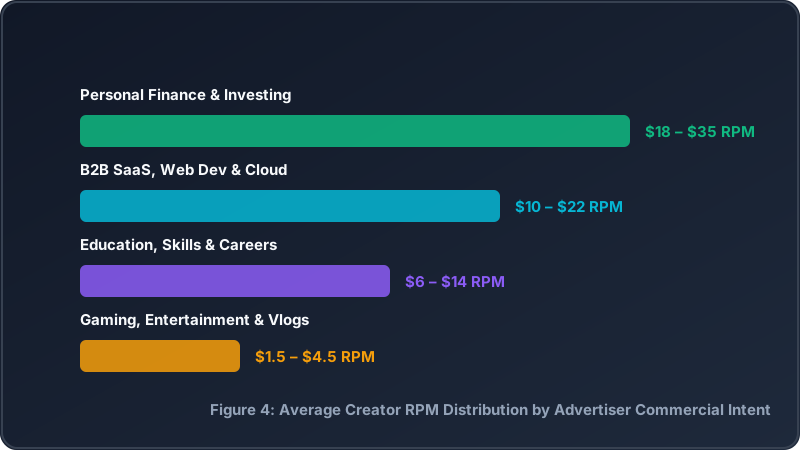
3. Niche RPM Benchmarks: High vs Low Commercial Intent
| Content Niche | Typical RPM Range (Tier 1 Views) | Primary Advertisers | Commercial Intent |
|---|---|---|---|
| Personal Finance & Investing | $14.00 – $38.00 | Fintech, Brokerages, Credit Cards | Maximum |
| B2B SaaS, Cloud & Web Dev | $10.00 – $24.00 | Cloud Hosts, CRM, Dev Tools | Very High |
| Education, Careers & Law | $6.00 – $15.00 | Universities, Certifications, B2B | High |
| Health, Fitness & Cooking | $3.00 – $7.50 | Supplements, Meal Kits, Equipment | Moderate |
| Gaming & Esports | $1.50 – $4.50 | PC Peripherals, Mobile Games, Snacks | Low |
| Comedy, Pranks & Viral Vlogs | $1.00 – $3.50 | FMCG, Fast Food, Cinema | Very Low |
4. Geographic Arbitrage: The Power of Tier 1 Viewers
Advertiser auction depth is concentrated heavily in Tier 1 English-speaking nations (United States, United Kingdom, Canada, Australia, and New Zealand). 10,000 views originating in the United States routinely generate more AdSense revenue than 150,000 views originating in Tier 4 emerging economies.
5. Long-Form Videos vs YouTube Shorts Economics
Videos that exceed 8 minutes in length allow creators to place manual mid-roll ads throughout the timeline. A viewer who watches a 20-minute video may see three ad breaks, tripling your ad impressions without requiring additional video views.
Conversely, YouTube Shorts monetize through a pooled revenue sharing model across the swipe feed. Average Shorts RPM ranges from $0.03 to $0.08 per 1,000 views. While Shorts can generate millions of impressions quickly, monetizing them via AdSense alone yields modest cash flow compared to long-form video.
6. Four Tactical Steps to Increase Your Channel RPM
- Produce Content Over 8 Minutes: Manually position mid-roll ads at natural narrative pauses.
- Target Commercial Intent Keywords: Review high-intent tools, software comparisons, and workflow tutorials rather than broad entertainment topics.
- Audit Your Audience Demographics: Shape topics and video pacing to attract adult professional demographics.
Test different traffic scenarios with our YouTube RPM Earnings Estimator to project your channel's true revenue ceiling.